Things to Do in Suwon
The best things to do in Suwon — Hwaseong Fortress and Haenggung Palace, Paldalsan, the market district, Chicken Street, Haenggung-dong, Starfield and what to skip on a day trip.
Suwon is the easiest place to add to a Seoul itinerary when you want something more substantial than another city neighbourhood and do not want to spend half the day travelling. Almost everything worth your time sits in one historic district, which is what makes a day here work.
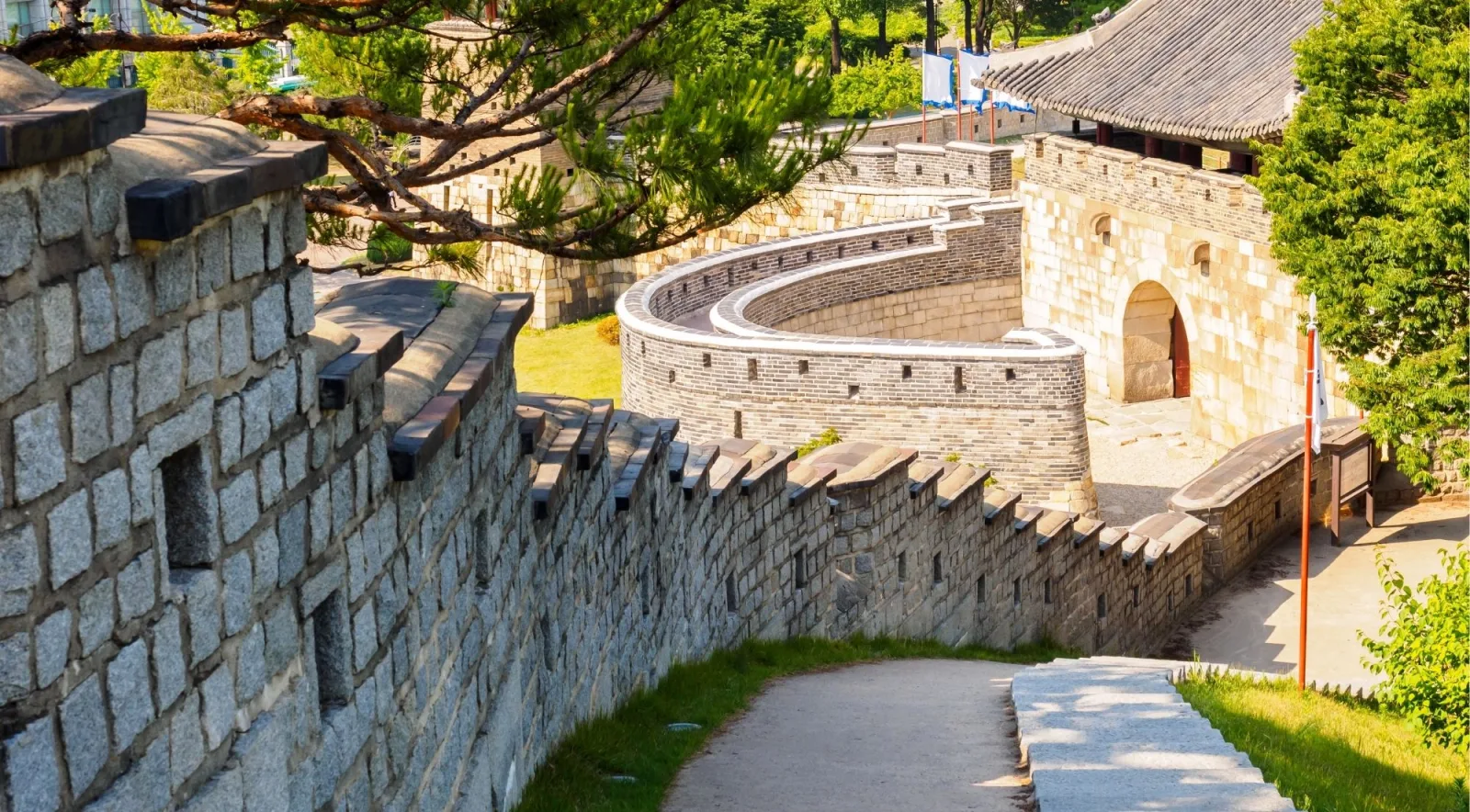
The anchor is Suwon Hwaseong Fortress, a UNESCO World Heritage Site whose wall wraps around the old centre for roughly 5.7 kilometres. Inside and along it you can see Hwaseong Haenggung Palace, climb Paldalsan for the view over the city, walk through traditional markets, eat Suwon-style fried chicken and wander the cafés and murals of Haenggung-dong. Further out there is Starfield Suwon and its library atrium, and the Korean Folk Village in Yongin pairs easily with the city on a full day.
Check Availability
One district, not a scattered city
What follows is eighteen things worth doing, and the first nine of them are within walking distance of each other. That is the single most useful fact about visiting Suwon: the fortress, the palace, the market district, the café streets and the fried-chicken alley all sit inside or just outside the same stretch of wall, so a day here is one long walk with stops rather than a series of transfers.
The attractions that are not in that district — Starfield Suwon, the museums, the arboretum, the Korean Folk Village in Yongin — each cost you a bus or taxi ride and a chunk of the afternoon. They are worth adding on a full day, an overnight or a second visit. On a first five or six hours they are not.
This list is therefore ordered by what most visitors should do, not by what a tourist office lists. It leaves out plenty of museums, parks and shopping centres in the wider city on purpose.
1. Walk Suwon Hwaseong Fortress
If you do one thing in Suwon, make it Hwaseong Fortress.
Built between 1794 and 1796 under King Jeongjo, it combines defensive walls, gates, observation towers, command posts, pavilions and water-control structures. The complete circuit runs about 5.7 kilometres, and you do not need to walk all of it.
For a first visit, concentrate on the strongest sections:
- Janganmun Gate — the monumental north gate
- Hwaseomun Gate — the western gate
- Hwahongmun — where the Suwoncheon stream runs beneath the fortress
- Banghwasuryujeong Pavilion — the most scenic stretch on the circuit
- Seojangdae — the command post high on Paldalsan, with the view across Suwon
- Changnyongmun Gate — the east gate
The fortress is free to visit and the wall is accessible around the clock.
For the history and the structure-by-structure detail, see our complete Hwaseong Fortress guide.
2. Visit Hwaseong Haenggung Palace
Many visitors arrive expecting Hwaseong to be one enclosed castle complex. It is not. The fortress surrounds a large part of the old city, and Hwaseong Haenggung Palace is a separate royal complex inside it.
A haenggung was a temporary palace used by the king when he travelled away from the main court in Seoul. Jeongjo stayed here on his visits to Suwon, particularly when travelling to the tomb of his father, Crown Prince Sado.
The palace is what explains the royal half of the Hwaseong story. Without it, a day in Suwon becomes mostly a walk past walls and gates.
Allow roughly 45 to 90 minutes, depending on how much Korean history and architecture you want.
It opens 09:00–18:00 from March to October and 09:00–17:00 from November to February, and charges ₩2,000 for adults, unlike the fortress itself. Our tickets and entrance fees guide lists every paid attraction on the site.
Why include it?
Choose the palace if you want:
- more historical context;
- traditional Korean architecture;
- courtyards and royal spaces;
- a break from walking the wall;
- a central starting point for the rest of the historic district.
It also sits beside the cafés of Haenggung-dong and the traditional market area.
3. Climb Paldalsan to Seojangdae
For the best elevated view of central Suwon, climb Paldalsan.
This is not a wilderness hike. Paldalsan rises directly beside the historic centre and the fortress wall runs across it. The destination on the hill is Seojangdae, the western command post, and from there modern Suwon spreads out beyond the wall and you can finally see how the defences were laid out around the old city.
The climb is the most strenuous part of a Hwaseong visit, on stone steps with a real incline. For a flatter day, take the northern and eastern sections instead.
Best for
- panoramic views;
- photographers;
- active travellers;
- autumn foliage;
- understanding the scale of the fortress.
4. See Janganmun, Suwon’s Great North Gate
Janganmun is the most impressive single structure at Hwaseong, and the largest surviving city gate in Korea — bigger than anything in Seoul. It has a broad stone base, a traditional wooden pavilion above it and a semicircular barbican wall screening the entrance.
Make time for it even if you are not walking the complete circuit. Its scale tells you far more about Hwaseong’s military architecture than a narrow stretch of wall does.
It also sits naturally on a walking route between Hwaseomun and the Hwahongmun area.
5. Walk to Hwahongmun and Banghwasuryujeong
For many visitors this is the prettiest part of Hwaseong.
Hwahongmun is where the Suwoncheon stream passes beneath the fortress through seven arches, so water management and the defensive line are solved in the same building. A short walk away, Banghwasuryujeong is a pavilion and former command post set above the water.
Together they give the best combination of architecture, water and rampart in Suwon.
If photography matters more to you than finishing the circuit, put this section first. It looks its best in the softer light of late afternoon.
6. Explore Haenggung-dong
The streets around Hwaseong Haenggung have become the most enjoyable part of the city to spend an hour in.
Haenggung-dong mixes traditional lanes with independent shops, cafés, small galleries and ordinary houses. It is where to slow down after the structured sightseeing at the palace and on the wall, and you will pass murals and streets that have appeared in Korean television dramas.
It works as part of your day rather than as a destination of its own: see the palace, walk through Haenggung-dong, stop for coffee, then carry on to the wall or the market.
Allow
About 45 to 90 minutes, longer with a café stop or any shopping.
7. Visit Paldalmun Market
Beside the fortress’s south gate is the most interesting area in Suwon for traditional markets.
This is not one market hall. The Paldalmun district holds a network of connected markets selling food, clothing and everyday goods, which makes it the obvious stop when you want a more local side of the city after the royal and military sights.
It combines easily with:
- Hwaseong Haenggung Palace;
- Paldalmun Gate;
- Suwon Chicken Street;
- the southern fortress area.
The stalls vary. Treat it as a walk instead of a checklist: go through, look around, stop where something interests you.
8. Eat on Suwon Chicken Street
Suwon is domestically famous for whole fried chicken, and Chicken Street is close enough to the fortress to be the easiest food stop of the day.
The alley behind Paldalmun is lined with long-running chicken restaurants where the birds are fried in large cauldrons and served plain or seasoned.
Nobody is pretending this is fine dining. The appeal is generous portions, crisp chicken and a loud local room, and for most travellers it lands best as an early dinner before the trip back to Seoul.
Good to know
Portions are large, which suits couples, families and small groups. Travelling alone, check the size before you order.
9. See Paldalmun Gate
Paldalmun is the southern gate of the fortress.
Unlike the quieter gates, it now stands ringed by roads and commercial buildings. That sounds like a loss and it is the point: Hwaseong was never preserved as an archaeological site apart from the city. The fortress is still embedded in a working one.
Paldalmun is also useful geographically, because it sits beside the traditional market district. Short on time, put together:
Hwaseong Haenggung → Paldalmun → traditional markets → Chicken Street
That is a compact half-day without walking the whole wall.
10. Ride or See the Hwaseong Tourist Train
Suwon runs tourist transport around parts of the fortress area, which covers more ground than you can walk in the same time.
Services and routes change. Check current Suwon tourism information shortly before you travel.
It is especially useful for:
- families with young children;
- older travellers;
- visitors with limited time;
- anyone visiting in very hot weather.
Do not treat it as a replacement for walking. The most atmospheric parts of Hwaseong still make more sense on foot.
11. Try the XR Bus Around Hwaseong
Suwon has also introduced an XR bus around the fortress.
The route runs roughly 40 minutes and uses transparent displays and onboard screens to recreate scenes tied to King Jeongjo and the construction of Hwaseong while the bus moves through the modern city.
It is a more contemporary way into the same history, and it works particularly well with teenagers or if you have already seen several conventional Korean palaces.
Schedules and ticketing change. Check what is running before you build an itinerary around it.
12. See the Fortress After Dark
Hwaseong is not only a daytime attraction. The wall stays accessible after the museums and the palace have closed, and the floodlit sections look like a different place.
Good stretches to come back to after dark:
- Janganmun;
- Hwahongmun;
- Banghwasuryujeong;
- the sections around Hwaseong Haenggung.
Suwon also runs a media-art projection season on the fortress most autumns — in 2026 it ran nightly from 19 September to 6 October at Hwaseomun, Janganmun and Jangan Park.
Evening visits work best in the warmer months, when the daytime heat makes long walks uncomfortable anyway. If you are heading back to Seoul the same night, the dedicated four-hour night tour drives you both ways.
13. Visit During the Suwon Hwaseong Cultural Festival
If your trip falls in autumn, check whether your dates overlap the Suwon Hwaseong Cultural Festival, an annual event that uses the fortress and Haenggung Square as its stage.
The 63rd edition runs 4 to 11 October 2026, centred on Haenggung Square, Hwaseong Haenggung, Banghwasuryujeong and Yeonmudae, with the re-enactment of King Jeongjo’s royal procession on the opening day. The dates move each year, so check the organiser’s programme for yours.
It can be the most interesting week of the year to be in Suwon, and the historic centre is busier than on an ordinary weekday. Plan around the programme if you want the festival; pick another date if you want quiet photographs.
14. Explore Starfield Suwon and Its Library
Suwon is not only Joseon-era history.
Starfield Suwon is a large modern shopping and entertainment complex, best known for its Byeolmadang Library — bookshelves rising across several floors, and one of the most photographed interiors in Korea.
It is outside the historic fortress district, so it does not belong on a short Hwaseong-focused visit. It makes sense if:
- you have a full day or an overnight stay;
- the weather is poor;
- you like modern Korean shopping centres;
- you want a photogenic indoor stop;
- you are in Suwon for a second time.
With five or six hours, the fortress district matters more.
15. Visit Suwon Museum
For context on the city and not only the fortress, there is Suwon Museum, whose exhibitions cover Suwon’s history and culture. VISITKOREA singles out its recreated streetscape of everyday Korean life in the 1960s.
This is a second-tier attraction for international visitors, and a good one on an overnight stay or in bad weather. On a short first visit, do not give up Hwaseong or the palace for it.
16. Visit the Suwon Center for Traditional Culture
The Suwon Center for Traditional Culture runs programmes tied to Korean traditions, including tea ceremony, etiquette and royal cuisine.
It suits anyone who would get more from a hands-on session than from another museum. Programme availability changes. Check what is running on your date instead of assuming every activity runs continuously.
17. Walk Through a Suwon Arboretum
For something completely unlike the fortress, Suwon has modern botanical spaces including Ilwol Arboretum.
It is not essential on a first Hwaseong day trip, and it gives repeat visitors and slower travellers an alternative to historical sightseeing. It earns its place if you are staying more than a day.
18. Combine Suwon with Korean Folk Village
Korean Folk Village is in Yongin rather than central Suwon, about thirty minutes east, and it is the attraction most often paired with Hwaseong on organised day trips from Seoul.
The two are quite different. Hwaseong is a genuine historic fortress and an urban heritage site. Korean Folk Village is an open-air cultural attraction of traditional buildings, demonstrations and performances built to show how Koreans lived. That is why they complement each other.
Doing both independently in one day means more transport planning; adult admission to the Folk Village alone is around ₩32,000, which is most of the gap between a self-organised day and a guided one. Seoul: Suwon Hwaseong, Starfield Library, Folk Village Tour covers the fortress, the palace, the library atrium and the village across ten hours from $73, rated 4.8 out of 5 from more than 130 reviews. See our Hwaseong Fortress and Korean Folk Village tours page for the alternatives.
How Many Things Can You Realistically Do in One Day?
Do not try to cover this whole list. For a day trip from Seoul, pick one of these four shapes.
Classic first-time Suwon day
- Hwaseong Haenggung Palace
- Paldalsan and Seojangdae
- Hwaseomun
- Janganmun
- Hwahongmun and Banghwasuryujeong
- Haenggung-dong
- Chicken Street or the traditional markets
The right choice for most first-time visitors.
Easier walking day
- Hwaseong Haenggung Palace
- Haenggung-dong
- Paldalmun
- Paldalmun Market
- Chicken Street
- a bus or taxi to one of the major northern or eastern fortress sections
This keeps the day from being entirely about climbing.
History + culture day
- Hwaseong Fortress
- Hwaseong Haenggung Palace
- Korean Folk Village
Easier on an organised tour, because these three are not in one walking zone.
Old Suwon + modern Suwon
- Hwaseong Fortress
- Hwaseong Haenggung
- lunch in the historic centre
- Starfield Suwon
Choose this to see both the heritage and the contemporary side of the city.
What Should You Skip If You Only Have Half a Day?
With three or four hours in Suwon, skip everything outside the fortress district. Do not try to add Starfield, an arboretum, the Korean Folk Village and a museum.
A good short route:
Hwaseong Haenggung → Paldalsan or Janganmun → Hwahongmun → Haenggung-dong
Or, if food matters more:
Hwaseong Haenggung → Paldalmun → market district → Chicken Street
The strength of Suwon is that so many of its best sights are packed around the wall.
How Long Should You Spend in Suwon?
3–4 hours
Enough for Hwaseong Haenggung and a chosen part of the fortress.
5–7 hours
The sweet spot for most day-trippers. The palace, substantial wall walking, markets or cafés and a meal, without rushing.
Full day
Best coming from Seoul if you want an unhurried visit or plan to include the Korean Folk Village.
Overnight
Worth it to see the fortress illuminated, to explore more of modern Suwon, or to attend an evening event. Most international visitors do not need to stay the night purely for Hwaseong.
Is Suwon Worth Visiting from Seoul?
For travellers interested in Korean history, architecture and easy day trips, yes.
The journey is short enough that Suwon does not consume the day through transport alone, and the city feels noticeably different from central Seoul. It is especially worth the trip once you have seen Seoul’s major royal palaces and want another side of Joseon-era history.
Suwon is less compelling if:
- you have only one or two days in Korea;
- shopping and nightlife are your priorities;
- you dislike walking;
- you are mainly after dramatic natural scenery.
For most visitors with four or more days based in Seoul, it is one of the easiest historical excursions to add. Our Suwon day trip from Seoul guide plans the day hour by hour.
Best Time to Visit Suwon
Spring
Good walking weather and blossom along the Suwoncheon make spring one of the easiest times to explore Hwaseong.
Summer
The wall is exposed on both hills, and Suwon gets hot and humid. Start earlier, take breaks, and give the hottest part of the day to the palace, the cafés or another indoor stop.
Autumn
The most appealing season for a fortress-focused trip. Temperatures usually suit walking, the foliage around Paldalsan turns, and the Hwaseong Cultural Festival falls in October.
Winter
The city is quieter and clear winter days give the best views of the year, though wind and cold are much more noticeable on the exposed sections.
How to Get to Suwon from Seoul
Most independent visitors travel first to Suwon Station, on Line 1 of the Seoul metropolitan subway and also served by faster rail from Seoul Station and Yongsan.
Do not make the common mistake of assuming Suwon Station is beside the fortress. Paldalmun is still about two kilometres north, so you continue by local bus — 11, 13, 36 or 39, roughly fifteen minutes — or by taxi.
For the full comparison, see Seoul to Suwon: train, subway, bus or guided tour?.
Should You Take a Guided Tour?
You do not need a tour to visit central Suwon.
A self-guided trip works well if you want:
- flexible timing;
- plenty of photography stops;
- time in cafés or markets;
- a low-cost day.
A tour earns its price if:
- you want the history explained;
- you would rather not navigate the transport;
- you are combining Hwaseong with the Korean Folk Village;
- you have limited time;
- you want a central-Seoul or hotel pick-up.
The strongest reason to book a guide here is context. Hwaseong is visually impressive on its own, and understanding King Jeongjo’s ambitions, Crown Prince Sado and the engineering of the wall is what makes the visit mean something. Seoul: Suwon Full-Day Trip to UNESCO Fortress & Trendy Spots is the most-booked Suwon day trip on this site — the fortress plus Starfield Library and Waujeongsa Temple, from $54, rated 4.8 out of 5 from more than 390 reviews. Our guide to which Hwaseong Fortress tour to book works through the rest of the catalogue by traveller type.
Frequently Asked Questions
What is Suwon best known for?
Internationally, Suwon is best known for Hwaseong Fortress, the UNESCO World Heritage Site built in the late 18th century. Domestically it is also known for whole fried chicken, for Hwaseong Haenggung Palace, and as a major modern city south of Seoul.
Is one day enough for Suwon?
Yes. One day covers the main sights around Hwaseong Fortress. You need more only to add several outlying attractions or to stay for an evening event.
Is Hwaseong Fortress free?
Yes. The fortress is free to access. Hwaseong Haenggung Palace charges ₩2,000 for adults, and some experiences have their own fees.
Can you walk around Suwon?
The historic Hwaseong district is very walkable, though the sections around Paldalsan are steep. Suwon as a whole is a large city, so anything outside the fortress area needs a bus or a taxi.
What food should you try in Suwon?
The easiest local speciality is Suwon fried chicken, on Chicken Street behind Paldalmun, beside the fortress and the market district.
Is Korean Folk Village in Suwon?
No. The Korean Folk Village is in Yongin, about thirty minutes east, and it is frequently paired with Suwon on day tours from Seoul.
Is Starfield Suwon near Hwaseong Fortress?
Not particularly. It is in a separate part of the city, so allow extra transport time to combine the two.
The Best Things to Do in Suwon for a First Visit
For a first day in Suwon, these seven come first:
- Hwaseong Fortress
- Hwaseong Haenggung Palace
- Paldalsan and Seojangdae
- Janganmun Gate
- Hwahongmun and Banghwasuryujeong
- Haenggung-dong
- Paldalmun Market and Suwon Chicken Street
That combination gives you the city’s strongest history, architecture, views, neighbourhood atmosphere and food without turning the day into a race across it.
The useful way to think about Suwon is not as a set of separate attractions but as one historic district around Hwaseong Fortress. Start there, pick the wall sections that interest you, add the palace, and give the rest of the time to the markets, the cafés or the food.
Walk a UNESCO Fortress Wall Before Dinner in Seoul
Suwon Hwaseong is 30 kilometres from central Seoul and open year-round. Compare guided day trips with transport, Haenggung Palace and the Korean Folk Village included — free cancellation on most departures.
Check Availability & Book