Suwon Day Trip from Seoul
How to spend one day in Suwon from Seoul — Hwaseong Fortress and Haenggung Palace, the transport routes compared, a timed itinerary, and when a guided day is the better buy.
Suwon is one of the easiest historic day trips out of Seoul, and one day is enough for the main fortress sights without rushing. Its centrepiece is Hwaseong Fortress, a UNESCO World Heritage Site whose wall runs about 5.7 kilometres around the old centre of the city. You can travel down by public transport, see Hwaseong Haenggung Palace, walk a substantial stretch of the wall and be back in Seoul for dinner. A guided day trip is the easier version of the same day: it removes two transfers and usually adds a second destination, most often the Korean Folk Village.
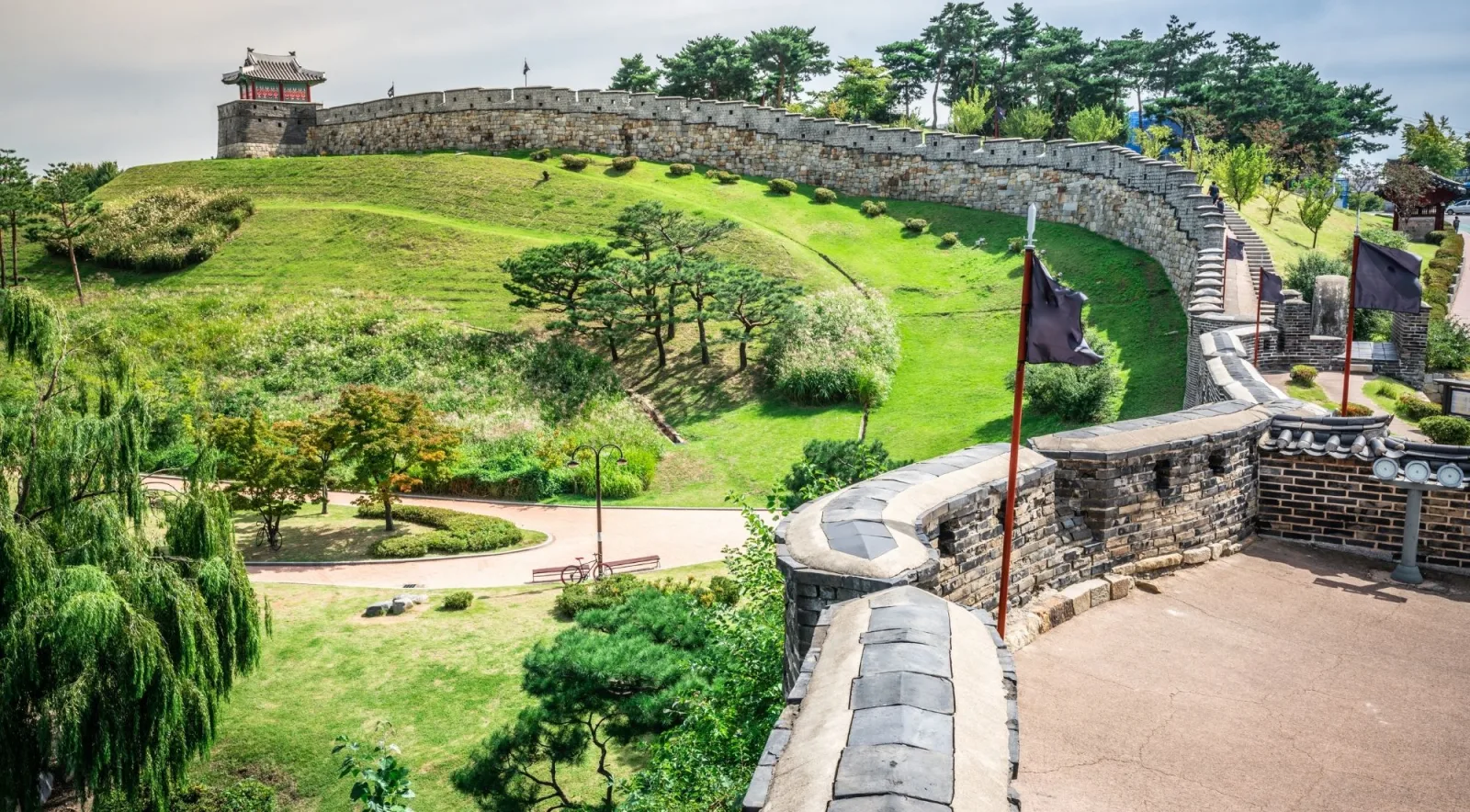
What makes Hwaseong different from a palace compound in Seoul is that it never stopped being part of the city. Gates open onto working roads, markets sit against the wall, and the viewpoints look out over tiled roofs and apartment towers in the same frame.
Check Availability
Quick answer: the best way to do a Suwon day trip
For a first visit, this is the plan that works:
- Leave Seoul in the morning.
- Travel to Suwon Station.
- Continue to Hwaseong Haenggung Palace by local bus or taxi.
- See the palace before you step onto the wall.
- Follow the rampart towards Hwaseomun and Janganmun, or keep going if you enjoy walking.
- Eat around Haenggung-dong or Paldalmun Market.
- Take in another section of the fortress during the afternoon.
- Return to Suwon Station and travel back to Seoul.
If you would rather not work out local buses on the day, book a full-day Suwon tour from Seoul instead and let the vehicle do the connecting.
Is Suwon worth a day trip from Seoul?
Yes, particularly if you want a break from Seoul’s palaces, shopping districts and modern neighbourhoods without committing to an overnight trip.
A Suwon day trip suits travellers who want:
- a UNESCO World Heritage Site within day-trip distance of Seoul;
- a long historic walking route instead of a single monument;
- Korean royal and military history;
- good photography from the fortress wall;
- a destination you can reach independently without joining a tour;
- history that comes with markets, cafés and another Gyeonggi attraction in the same day.
The main reason to come is Hwaseong itself. The fortress was built between 1794 and 1796 under King Jeongjo, and the walls, gates, guard posts and defensive structures still make one of Korea’s most distinctive historic urban landscapes. The gun ports along the parapet are angled three ways, because this was a wall designed for firearms.
Seoul to Suwon: how to get there
Suwon sits about 30 kilometres south of central Seoul, connected to the capital by rail and by the metropolitan subway network. Journey time moves a lot with where in Seoul you start and which service you use, so plan from your own accommodation instead of from one universal figure. Our Seoul to Hwaseong Fortress guide times each route properly.
By subway
The subway is usually the cheapest option and is straightforward if you are comfortable with Seoul’s public transport.
You take Line 1 to Suwon Station — roughly an hour on the local service from Seoul Station — then continue by local bus or taxi towards the fortress. Suwon Station is not beside the wall; buses 11, 13, 36 and 39 cover the last leg to Paldalmun in about fifteen minutes, so allow for that part of the journey rather than treating the station as the destination.
This option is best for:
- budget travellers;
- independent visitors;
- travellers who do not mind a longer urban transit journey;
- anyone staying somewhere with an easy connection to Line 1.
By train
Faster rail services cut the time between central Seoul and Suwon. Depending on where you start and which departure you catch, leaving from Seoul Station or another rail hub can be more comfortable than riding the subway the whole way.
The trade-off is that you plan around specific train times instead of tapping onto the metro whenever you are ready.
By guided tour
A guided day trip is the least complicated way to visit Suwon from Seoul. Departures gather at a named central Seoul meeting point — Myeongdong and Hongik University Station cover most of them — and the itinerary usually pairs Hwaseong with something else in Gyeonggi Province.
That makes sense if:
- you have only a few days in Seoul;
- you want the history explained as you walk it;
- you would rather not navigate local transport in Suwon;
- you want several attractions in one day.
Best guided Suwon day tours from Seoul
Two shapes of tour fit this itinerary, and they answer different questions.
1. Suwon-focused full-day tour
Seoul: Suwon Full-Day Trip to UNESCO Fortress & Trendy Spots is the most-booked Suwon day trip on this site, rated 4.8 out of 5 from more than 390 reviews and starting at $54. It runs nine and a half to ten hours and pairs Hwaseong Fortress with Starfield Suwon’s Byeolmadang Library and Waujeongsa Temple, with transport from central Seoul included.
Best for: visitors who want Suwon old and new in one day. Our Suwon day trips from Seoul page sets it against the other multi-stop itineraries.
2. Hwaseong Fortress + Korean Folk Village
Several operators pair the fortress with the Korean Folk Village in Yongin, about thirty minutes east. This is the combination to book if your priority is Korean history and traditional culture over modern Suwon. It is also the best value on the site: adult admission to the Folk Village alone is around ₩32,000.
Seoul: Suwon Hwaseong Fortress & Folk Village or Starfield runs nine to eleven hours from $52 and is rated 4.7 out of 5 from more than 240 reviews, the longer review record of the two. Seoul: Suwon Hwaseong, Starfield Library, Folk Village Tour is a ten-hour version at $73, rated 4.8 out of 5 from more than 130 reviews, which adds the library atrium to the same two anchors.
Best for: travellers who want a history-heavy day trip with the transport arranged. Our Hwaseong Fortress and Korean Folk Village tours page compares what each one gives you at the village.
What to see at Hwaseong Fortress
Hwaseong is not one building. It is a long defensive system of gates, walls, military structures and viewpoints strung across central Suwon.
Seeing every metre of it is possible if walking is the point of your trip. Most first-time visitors have a better day by choosing the strongest sections and giving the rest of the time to the palace and the neighbourhoods around it. Our complete Hwaseong Fortress guide goes structure by structure.
Hwaseong Haenggung Palace
Start here if you want the rest of the day to make sense.
A haenggung was a temporary royal palace, used when the king travelled away from the main court. King Jeongjo stayed at the Suwon palace during visits to his father’s tomb, and the complex became a central part of the royal story behind the fortress.
The palace is separate from the open wall and charges its own admission. Published prices are ₩2,000 for adults, ₩1,500 for teenagers and military, and ₩1,000 for children, and it opens 09:00–18:00 from March to October and 09:00–17:00 from November to February. Suwon also runs evening openings on selected dates in the warmer months. Our tickets and entrance fees guide lists every paid attraction on the site.
Paldalmun Gate
Paldalmun is the southern gate and one of the most recognisable structures on the circuit. Where other stretches of wall lift you out of the city, Paldalmun sits in the middle of it, ringed by roads and shopfronts.
It is the clearest place to see what makes Hwaseong unusual: the fortress was never preserved as an isolated archaeological site. Modern Suwon grew around and through it.
Hwaseomun Gate
Hwaseomun is the western gate, and one of the best-looking sections of the fortress. It works well on a walking route from the palace area towards Janganmun.
The barbican beside it — an outer screen wall that turned the entrance into a killing ground — and the sweep of the ramparts make this one of the best stretches for photographs.
Janganmun Gate
Janganmun is the north gate and the largest surviving city gate in Korea, bigger than anything in Seoul. If you are walking a portion of the wall instead of the full circuit, the stretch from the western side round to Janganmun gives you ramparts, gate architecture and city views in one leg.
The fortress walls
The complete circuit is about 5.7 kilometres, which is not the same thing as an easy 5.7-kilometre city stroll. Part of it climbs over Paldalsan on stone steps, and you will stop often for gates, viewpoints and photographs.
With one day in Suwon there is no need to walk the whole thing unless finishing it is one of your goals.
Can you visit Hwaseong Fortress for free?
Yes. The fortress is free to access and VISITKOREA lists it as open around the clock.
That is what makes Suwon good value for independent travellers: you can walk the wall and see the gates without buying a general admission ticket at all.
Individual attractions inside the fortress area are a separate matter. Hwaseong Haenggung Palace charges its own entrance fee, and the tourist trolley, the archery range and the tethered balloon are ticketed when they are running.
A practical one-day Suwon itinerary from Seoul
8:00-9:00 — Leave Seoul
An early start gives you the fortress without watching the clock all afternoon.
Travelling independently, aim to arrive in Suwon in the morning instead of around lunchtime — you still have the last leg from the station to the historic centre ahead of you.
10:00 — Hwaseong Haenggung Palace
Begin at the palace. Allow roughly 45 to 60 minutes to look round properly without going into museum-level detail.
Starting here also puts you beside the restaurants, cafés and the western approach to the wall.
11:00 — Walk toward the fortress walls
From the palace, head for the ramparts and start walking. Take in Paldalsan and the Seojangdae command post for the energetic version of the route, or stay on the flatter sections if you mainly want the architecture and the photographs.
12:30 — Lunch in Haenggung-dong
Haenggung-dong has become the pleasantest place to stop during a fortress visit. The historic streets now hold cafés, restaurants and small shops, so you do not have to leave the sightseeing area to eat.
The market area is the alternative if you prefer a more traditional local-food stop — Tongdak Alley behind Paldalmun sells the whole fried chicken Suwon is domestically famous for.
14:00 — Hwaseomun and Janganmun
Give the early afternoon to another stretch of the wall. Hwaseomun and Janganmun pair naturally and deliver some of the most impressive architecture on the circuit without asking you to complete it.
15:30 — Choose your final stop
Decide here according to how much walking is left in you.
Option A: keep walking Carry on round the wall if the fortress is your main interest.
Option B: Suwon Hwaseong Museum Go to the museum if you want more on how the fortress was designed and built.
Option C: café break in Haenggung-dong The better choice once you have several kilometres behind you.
Option D: Hwaseong tourist vehicle When it is running, it covers more of the area with much less walking.
17:00-18:00 — Return toward Suwon Station
Head back to the station and travel to Seoul.
If you are visiting on a date when Hwaseong Haenggung opens at night, you could stay into the evening and see the historic area lit before you go back.
Should you walk the entire fortress?
You can, and you do not need to.
The complete circuit makes sense if:
- you enjoy long urban walks;
- Hwaseong is the main purpose of the day;
- the weather is comfortable;
- you want the quieter defensive structures as well as the famous gates.
A partial walk is better if:
- you are visiting in midsummer;
- you want time inside the palace;
- you are combining Suwon with another attraction;
- you have children with you, or anyone who finds hills difficult;
- you prefer slower sightseeing with cafés and lunch stops.
For most first-time visitors, the palace plus two or three strong fortress sections makes a better day than ticking off every metre of wall.
Suwon independently vs guided tour
Visit independently if you want flexibility
An independent trip is inexpensive and reasonably easy. You choose how much of the fortress to walk and how long to spend in cafés, markets or the museum.
The drawback is that Hwaseong is historically complicated. Without a guide it can become a very handsome walk past gates and walls whose purpose stays opaque.
Take a guided tour if you want context
A guide brings King Jeongjo, the design of the fortress, the military engineering and the political ambition behind the creation of Suwon. The walls were up in two years and nine months because Jeong Yak-yong built a lifting crane for the job, and that is the sort of thing you only get told.
Tours also solve the transport problem and can pack several Gyeonggi attractions into one day.
The cost is the obvious one: you give up flexibility and get a fixed amount of time at each stop. Our guide to which Hwaseong Fortress tour to book works through the catalogue by traveller type.
Hwaseong Fortress or Korean Folk Village?
With time for only one, choose by what you want from the day.
Choose Hwaseong Fortress if you prefer:
- authentic historic architecture and fortifications;
- UNESCO sites;
- walking;
- city views;
- royal and military history.
Choose Korean Folk Village if you prefer:
- reconstructed traditional environments;
- cultural performances;
- demonstrations and family-friendly activities;
- a more structured attraction.
With a full day and no objection to a quick pace, a guided tour covering both is the easiest way to see them together. Seoul: Suwon Hwaseong Fortress & Folk Village or Starfield is the most-reviewed of those pairings.
Best time for a Suwon day trip
Suwon can be visited throughout the year, and the weather changes the day considerably.
Spring
Comfortable temperatures make spring one of the easiest seasons for walking the wall. Blossom along the Suwoncheon and fresh foliage improve the views from the ramparts.
Summer
The fortress is still visitable, but heat, humidity and rain make a full circuit tiring, and both hills are exposed. Plan shorter walking sections and take breaks through the hottest part of the day. Several operators move their departures into the late afternoon from June to August for exactly this reason.
Autumn
Autumn is particularly good for Hwaseong: the weather usually suits walking, and the foliage around the wall and Paldalsan adds colour to the views.
Suwon’s autumn cultural programme, including the Suwon Hwaseong Cultural Festival, makes it an interesting period as well, although event days are busier than normal.
Winter
Winter brings clearer views on many days and thinner crowds, but the exposed sections feel very cold. Good footwear matters if conditions are icy or snowy.
How much time do you need in Suwon?
For a day trip from Seoul, allow roughly 6 to 8 hours in Suwon itself to see the palace, walk substantial sections of the fortress, stop for lunch and not rush.
A half-day visit is possible if you are selective. In that case, prioritise:
- Hwaseong Haenggung Palace;
- one scenic section of the fortress wall;
- one major gate.
For the complete wall walk plus museums, markets and an unhurried evening in Suwon, consider staying longer or spending a night.
Is Suwon easy to visit without a car?
Yes. A Suwon day trip does not need a rental car.
Public transport gets you from Seoul to Suwon Station, and buses or taxis connect the station with the fortress district. Once you are in the historic centre, most of the sightseeing is on foot anyway.
A car can be the less convenient option if your main goal is walking the fortress, because you may finish the wall a long way from where you parked.
What to bring
For a straightforward day trip, bring:
- comfortable walking shoes;
- water, particularly in warm weather;
- sun protection in spring and summer;
- an extra layer in autumn and winter;
- a transport card for local buses and the subway;
- a charged phone for the leg between Suwon Station and the fortress.
Is one day enough for Hwaseong Fortress?
Yes. One day is enough for the large majority of visitors.
You can see the palace, walk several of the strongest sections of the fortress, eat in the historic district and still be back in Seoul in the evening.
The question is not whether one day is enough. It is how much of the 5.7-kilometre wall you want to walk.
If history and sightseeing come first, give the day to the palace and the best fortress sections. If the walk itself is the point, give most of it to the circuit.
Frequently Asked Questions
How far is Suwon from Seoul?
Suwon is about 30 kilometres south of Seoul in Gyeonggi Province. Journey time depends on where you start in Seoul and whether you take the subway, a faster train or a guided transfer — Line 1 from Seoul Station to Suwon Station is roughly an hour on the local service.
Is Hwaseong Fortress free?
Yes. The fortress itself is free to access and listed as open around the clock. Paid attractions such as Hwaseong Haenggung Palace charge separate admission, at ₩2,000 for adults.
How long is Hwaseong Fortress?
The fortress wall runs for approximately 5.7 kilometres around the historic centre of Suwon.
Can you walk all the way around Hwaseong Fortress?
Yes, and you should allow substantially more time than an ordinary 5.7-kilometre walk, because of the climb over Paldalsan, the sightseeing stops and the photographs.
Do I need a tour for Suwon?
No. Suwon is easy to visit independently. A guided tour earns its price when you want the history explained, want the transport handled, or want to combine Hwaseong with another attraction in one day.
What is the best Suwon tour from Seoul?
For a broad look at the city, a full-day tour pairing Hwaseong Fortress with Suwon’s other attractions is the strongest option. For a history-focused day, a tour combining Hwaseong Fortress and the Korean Folk Village fits better.
Can I visit Suwon and Korean Folk Village in one day?
Yes, though it is substantially easier on an organised tour: the Korean Folk Village sits outside central Suwon in Yongin and adds another transport leg to the day.
Final thoughts
A Suwon day trip from Seoul works because it is easy and genuinely different from another day of sightseeing in the capital. Hwaseong gives you a long historic landscape to explore instead of a single palace or museum, and the wall still meets the living city at every gate.
Independent travellers can make an inexpensive day of it on public transport and their own feet. Anyone who wants the context — or wants to add the Korean Folk Village or another Gyeonggi attraction — will get more out of a guided day.
Either way, do not treat Hwaseong as a quick photo stop. Give yourself enough time to walk at least one substantial section of the wall, see Hwaseong Haenggung Palace, and watch how the old fortress fits into modern Suwon.
Useful official sources
- Suwon Tourism — Hwaseong Haenggung Palace
- VISITKOREA — Suwon Hwaseong Fortress
- VISITKOREA — Hwaseong Haenggung Palace
Walk a UNESCO Fortress Wall Before Dinner in Seoul
Suwon Hwaseong is 30 kilometres from central Seoul and open year-round. Compare guided day trips with transport, Haenggung Palace and the Korean Folk Village included — free cancellation on most departures.
Check Availability & Book