Hwaseong Fortress: The Complete Visitor Guide
A practical guide to Suwon Hwaseong Fortress — the gates and command posts worth your time, Hwaseong Haenggung Palace, how long you need, walking routes, seasons and tours.
Hwaseong Fortress is the reason most travellers make the trip from Seoul to Suwon, and it is much more than a single castle or gate. The UNESCO-listed wall wraps around the historic centre for roughly 5.7 kilometres, crossing flat city streets and the slopes of Paldalsan, and carrying monumental gates, command posts, watchtowers and viewpoints over modern Suwon along the way.
The fortress is free to walk and open around the clock, so no ticket is needed to get onto the wall. The one substantial paid attraction inside the fortress area is Hwaseong Haenggung Palace, the temporary royal palace King Jeongjo used when he travelled down from Seoul.
Allow at least three to four hours for the main sights on a first visit. If you want a long stretch of the wall, the palace, food and time in the neighbourhood around it, give Suwon a full day.
Check Availability
Hwaseong Fortress at a Glance
- Location: Suwon, Gyeonggi-do, South Korea
- UNESCO status: World Heritage Site since 1997
- Wall length: about 5.7 kilometres
- Fortress admission: free
- Fortress hours: open 24 hours
- Best amount of time: 3 to 5 hours for the highlights; a full day for an unhurried visit
- Main paid sight: Hwaseong Haenggung Palace, ₩2,000 for adults
- Best for: history, architecture, walking, photography and easy day trips from Seoul
If you are staying in Seoul, our Suwon day trip from Seoul guide has the transport options and a timed one-day itinerary.
What Is Hwaseong Fortress?
Hwaseong was built between 1794 and 1796 under King Jeongjo of the Joseon dynasty.
It was never only a defensive wall. Jeongjo wanted Suwon to become a political and economic centre, and the fortress combined military, administrative and commercial functions from the start. One of the reasons for developing the area was the relocation of his father Crown Prince Sado’s tomb to the Suwon region.
What makes Hwaseong interesting is the mixture in it: Korean fortress-building tradition alongside military and engineering ideas that had reached Korea from elsewhere in East Asia and from Europe. The parapet carries firing ports angled three ways for firearms, there is a beacon tower with five chimneys for fire signals, and floodgates carry the Suwoncheon stream through the wall.
The whole build is documented down to the wage bill. The Hwaseong Seongyeok Uigwe recorded every measurement, material and worker’s payment, which is why the reconstruction after the Korean War could be faithful instead of approximate. UNESCO describes Hwaseong as an important example of late-18th-century military architecture, and notes how it was adapted to both flat and hilly ground.
Is Hwaseong Fortress Worth Visiting?
Yes — particularly if you want an easy cultural day trip from Seoul without travelling for several hours across South Korea.
Hwaseong offers something quite different from Seoul’s royal palaces. Instead of moving through one enclosed historic compound, you walk along a wall that continues through a working modern city. One moment you are standing on an 18th-century defensive structure; a few minutes later you are looking over apartment blocks, cafés and traffic.
It is particularly worthwhile for:
- travellers interested in Korean history;
- people who enjoy walking and viewpoints;
- photographers;
- visitors who have already seen Seoul’s main palaces;
- travellers who want a day trip from Seoul without a very early start.
It matters less if you have only one or two days in Seoul and have not yet seen Gyeongbokgung, Bukchon or the city’s main neighbourhoods.
The Best Things to See at Hwaseong Fortress
You do not need to inspect every structure along 5.7 kilometres to appreciate Hwaseong. A handful of places stand out.
Janganmun Gate
Janganmun is the northern gate and the best place to take in the scale of the fortress. It is the largest surviving city gate in Korea, bigger than anything in Seoul: a broad stone base topped by a traditional wooden pavilion, with a curved barbican wall screening the entrance in front of it.
On a short visit, include Janganmun.
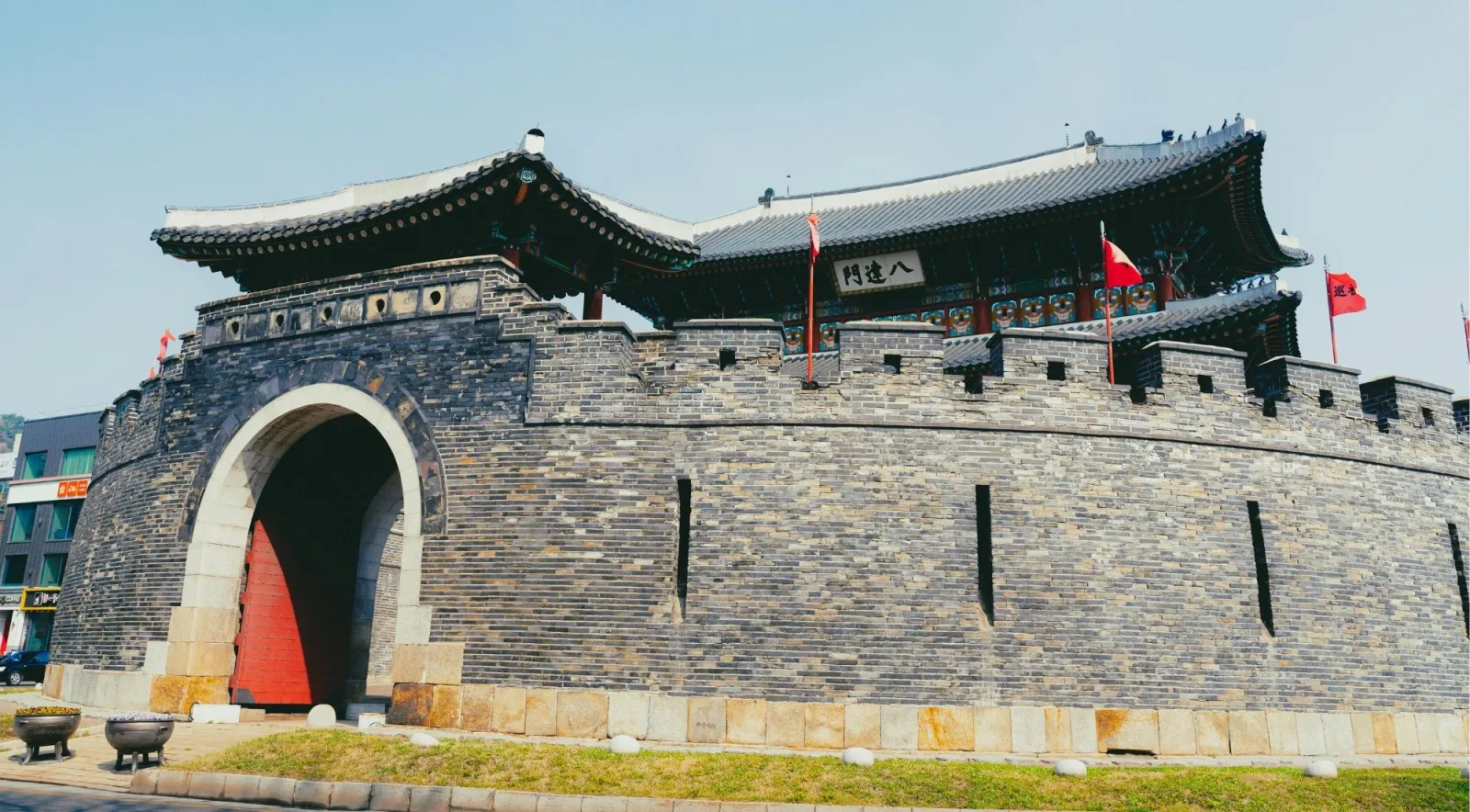
Paldalmun Gate
Paldalmun marks the southern side.
Unlike the quieter stretches of wall, it now stands in the middle of the modern city, ringed by roads and shopfronts. That contrast between 18th-century architecture and present-day Suwon is part of what makes the fortress unusual.
Paldalmun is also close to the markets and to the route towards Hwaseong Haenggung Palace.
Hwaseomun Gate
Hwaseomun, the western gate, is another handsome section and connects naturally with the climb towards the higher ground around Paldalsan.
This side of the fortress is a good choice if you want views as well as architecture.
Changnyongmun Gate
Changnyongmun is the eastern gate.
The eastern side of Hwaseong is relatively open and flat, which makes it a good place to start or finish if you would rather not begin by climbing Paldalsan.
Hwahongmun
Hwahongmun is one of the fortress’s most distinctive structures. The Suwoncheon stream runs through seven arches beneath it, so water management and the defensive line are solved in the same building.
It photographs well and sits easily alongside the wall sections either side of it.
Banghwasuryujeong Pavilion
Near Hwahongmun, Banghwasuryujeong is one of the prettiest spots on the circuit.
It served as a command post and now reads as a scenic pavilion, looking over the water and the ground around it.
If photography is one of your priorities, route yourself past this one.
Seojangdae Command Post
For views, climb to Seojangdae, the western command post on Paldalsan.
This is the highest and most rewarding part of the circuit, with the whole of Suwon spread out below it.
The trade-off is the climb, which is on stone steps with a real incline. With limited mobility, or with no appetite for spending much of your visit going uphill, the flatter northern and eastern sections are the better use of your time.
Hwaseong Haenggung Palace
Do not confuse Hwaseong Fortress with Hwaseong Haenggung Palace. They are connected historically and geographically, and they are separate attractions.
A haenggung was a temporary palace used by the king when he travelled away from the main court. Jeongjo stayed at Hwaseong Haenggung during visits to his father’s tomb, and the palace also hosted major royal events. It is the largest surviving temporary palace of the Joseon dynasty, and it gives the rest of the fortress its context.
Unlike the wall, Hwaseong Haenggung requires a ticket.
Published opening hours are:
- March–October: 09:00–18:00
- November–February: 09:00–17:00
Published admission is ₩2,000 for adults, ₩1,500 for teenagers and ₩1,000 for children. Check the official listing shortly before you travel in case hours or prices change. Our tickets and entrance fees guide prices out every paid attraction inside the fortress area.
On a first visit, include the palace instead of giving the whole day to the wall.
Can You Walk the Entire Hwaseong Fortress?
Yes, and most visitors do not need to.
The wall runs for approximately 5.7 kilometres, and the route is not flat. The western section climbs Paldalsan; other stretches are much easier.
A complete walk therefore takes considerably longer than the distance suggests, especially with stops at gates, towers and viewpoints.
For a dedicated walking day, finishing most or all of the circuit is genuinely rewarding. For a normal Seoul-to-Suwon day trip, choosing the strongest sections beats treating the visit as a race to complete the wall.
A good first-time combination is:
Hwaseong Haenggung → Paldalsan and Seojangdae → Hwaseomun → Janganmun → Hwahongmun → Banghwasuryujeong
That gives you palace history, the elevated views, the major gates and the prettiest scenery on the circuit.
How Long Do You Need at Hwaseong Fortress?
2 hours
Enough for a very selective visit.
Pick one or two gates, a short section of wall and perhaps the area around Hwahongmun. This works when Suwon is one stop on a broader tour.
3–4 hours
A good minimum for a first visit.
You can see Hwaseong Haenggung Palace, walk a substantial section of the wall and take in several of the major structures.
5–7 hours
Best when Hwaseong is the main purpose of your Suwon trip.
This gives you time to explore without rushing, stop for lunch or coffee, and see both the palace and several sections of the fortress.
Full day
Choose a full day if you also want the markets, the neighbourhoods or another attraction around Suwon — or if your tour pairs Hwaseong with the Korean Folk Village.
Guided Tour or Self-Guided?
Hwaseong works well both ways.
Visit independently if:
- you prefer walking at your own pace;
- you are comfortable using Korean public transport;
- architecture and photography interest you more than detailed historical interpretation;
- you want the cheapest option.
Because the wall itself is free, an independent visit can cost you little beyond the fare.
Take a guided tour if:
- you want the history explained instead of just seeing the structures;
- you are coming from Seoul and would rather have the transport arranged;
- you want to combine Suwon with another attraction;
- you have limited time and want someone else managing the route.
The history here carries the site. Without it, many of the gates, towers and defensive features look much alike. A good guide can explain why the fortress was built, how Jeongjo’s political ambitions shaped Suwon, and why the engineering was unusual for its date — Jeong Yak-yong’s lifting crane is the reason the whole thing went up in two years and nine months.
Two departures cover most of what people want. From Seoul: Suwon Hwaseong Fortress Tour is the exact-match product and the highest-rated high-volume tour on this site, at 4.9 out of 5 from more than 130 reviews, starting at $52; the same listing sells a longer version that adds the Korean Folk Village. Seoul: Suwon Hwaseong, Gwangmyeong Cave, Starfield Library gives the wall more time than any other multi-stop day — 90 minutes on the ramparts plus a full hour at the palace — over nine hours from $65, rated 4.7 out of 5 from more than 260 reviews.
For the full range, see our Hwaseong Fortress tours from Seoul page and our guide to which Hwaseong Fortress tour to book.
Hwaseong Fortress or Korean Folk Village?
These are very different days out, even though tours frequently combine them.
Choose Hwaseong Fortress if you prefer:
- real historic architecture;
- UNESCO heritage;
- walking;
- military and royal history;
- city views.
Choose Korean Folk Village if you prefer:
- reconstructed traditional environments;
- cultural demonstrations;
- performances;
- traditional houses;
- a more theme-park-like cultural experience.
With a whole day, combining the two makes sense, particularly on an organised tour where the thirty-minute transfer between them is handled for you. Seoul: Suwon Hwaseong Fortress & Folk Village or Starfield is the most-reviewed of those pairings, rated 4.7 out of 5 from more than 240 reviews and starting at $52. Our Hwaseong Fortress and Korean Folk Village tours page compares the options.
Best Time to Visit Hwaseong Fortress
Hwaseong is open year-round, and the walking changes considerably by season.
Spring
One of the most pleasant periods for the wall, with mild temperatures and blossom along the Suwoncheon.
Summer
Expect heat, humidity and spells of heavy rain. Because almost all of the visit is outdoors and both hills are exposed, early morning or late afternoon is more comfortable than the middle of the day. Several operators move their Suwon departures into the evening from June to August for the same reason.
Autumn
One of the best seasons for walking the wall, particularly once temperatures drop and the foliage around Paldalsan turns.
Suwon also hosts the Suwon Hwaseong Cultural Festival in autumn, although the dates and the programme vary by year.
Winter
The fortress stays open and can be atmospheric in winter, though the exposed sections feel considerably colder than a street in central Seoul.
Snow makes the wall particularly photogenic; ice makes the steep sections less comfortable.
When Should You Arrive?
If Hwaseong Haenggung Palace is on your list, plan around the palace hours instead of the wall, which is accessible at any time.
For photography and comfortable walking, morning and late afternoon usually beat the middle of the day.
An early start is not essential in the way it is for longer excursions out of Seoul. Suwon is close enough that you can leave after breakfast and still have a substantial day.
How to Get to Hwaseong Fortress from Seoul
The usual approach is to travel from Seoul to Suwon Station, then continue to the historic centre by local transport.
Suwon is connected to Seoul by regular rail, faster train services and the metropolitan subway network, and the best option depends on where you are staying.
Once you arrive, remember that Suwon Station is not beside the fortress. Buses 11, 13, 36 and 39 cover the last leg to Paldalmun in about fifteen minutes, and a taxi does it faster.
For the routes broken down step by step, read Seoul to Hwaseong Fortress: train, subway, bus or tour?.
What to Wear
Comfortable walking shoes matter more here than at most urban attractions.
Even without the full circuit, you are likely to cover a few kilometres and meet stairs and slopes on the way.
Bring:
- comfortable shoes;
- water in warm weather;
- sun protection in summer;
- layers in spring and autumn;
- a warm outer layer and gloves in winter.
If rain is forecast, remember that most of the attraction is outdoors.
Is Hwaseong Fortress Good for Families?
It can be, particularly for older children who enjoy exploring walls, gates and towers.
Families do not need the full circuit. A shorter route around the flatter portions plus Hwaseong Haenggung is much easier to manage.
With very young children or a pushchair, check your exact route before setting out, because the sections around Paldalsan involve stairs and steeper paths.
Is Hwaseong Fortress Free?
Yes. Walking around Suwon Hwaseong Fortress is free.
That makes it one of the better-value historical day trips from Seoul.
A free fortress does not mean a free day out, though. Hwaseong Haenggung Palace charges admission, and the tourist trolley, the archery range and the tethered balloon are ticketed separately when they are running.
Guided tours from Seoul charge for transport and guiding, and what each one includes varies between operators.
Is Hwaseong Fortress Open at Night?
The fortress is listed as open 24 hours, so you can see sections of it after dark, and the walls, gates and watchtowers are floodlit.
That does not extend to everything in the area. Hwaseong Haenggung Palace, visitor facilities and the commercial attractions keep their own hours, and the palace opens for special evening admission only on selected dates.
An evening visit works particularly well when atmosphere matters more to you than getting inside a paid attraction. From Seoul: Suwon Hwaseong Fortress Night Tour is the only dedicated evening departure — four hours to the floodlit walls and back, from $69, rated 4.8 out of 5 from more than 90 reviews. Our Hwaseong Fortress night tours page has the detail.
Do You Need a Tour?
No. Hwaseong is easy enough to visit independently once you know how to reach it from Suwon Station.
A tour adds value in two ways.
First, the story here is more complicated than it looks. Jeongjo, Crown Prince Sado, the founding of a second capital and the fortress’s unusual military design make the structures mean something.
Second, an organised day solves the transport problem if you want to pair Hwaseong with the Korean Folk Village or another attraction outside central Suwon.
So the question is less whether a tour is necessary and more whether you want context and convenience.
A Simple First-Time Hwaseong Fortress Itinerary
For a straightforward route instead of trying to see everything:
- Arrive in central Suwon.
- Visit Hwaseong Haenggung Palace.
- Walk uphill towards Paldalsan and Seojangdae.
- Continue towards Hwaseomun Gate.
- Follow the wall to Janganmun Gate.
- Carry on to Hwahongmun.
- Finish around Banghwasuryujeong Pavilion.
- Eat nearby, or head back towards Suwon Station.
That route gives you a much better cross-section of the fortress than photographing one gate and leaving.
Frequently Asked Questions
Where is Hwaseong Fortress?
Hwaseong Fortress is in Suwon, in Gyeonggi-do Province, about 30 kilometres south of Seoul.
Is Hwaseong Fortress in Seoul?
No. It is in Suwon, close enough to Seoul to visit comfortably as a day trip.
How long is Hwaseong Fortress?
The fortress wall runs for approximately 5.7 kilometres.
When was Hwaseong Fortress built?
Construction ran from 1794 to 1796, during the reign of King Jeongjo.
Is Hwaseong Fortress a UNESCO World Heritage Site?
Yes. UNESCO inscribed Hwaseong Fortress on the World Heritage List in 1997.
How much does Hwaseong Fortress cost?
The fortress is free to enter. Hwaseong Haenggung Palace charges separate admission, at ₩2,000 for adults, ₩1,500 for teenagers and ₩1,000 for children.
Can you visit Hwaseong Fortress at night?
Yes. The fortress is listed as open 24 hours and the walls are floodlit, although individual attractions and facilities in the area keep separate hours.
Can you visit Hwaseong Fortress from Seoul in one day?
Yes. It is one of the most practical historical day trips from Seoul, and you can see the main fortress highlights and the palace comfortably in a single day.
Final Thoughts
Hwaseong deserves more than a quick photo stop.
The fortress is large enough to explore on foot, historically important enough to reward some background reading, and close enough to Seoul that you do not need to plan a complicated overnight trip around it.
For most first-time visitors the best approach is to combine Hwaseong Haenggung Palace, one elevated section around Paldalsan, several of the major gates and the Hwahongmun–Banghwasuryujeong stretch instead of trying to inspect every metre of wall.
If you are still deciding between travelling independently and booking transport with a guide, carry on with our Suwon day trip from Seoul guide and the Hwaseong Fortress tours from Seoul comparison.
Walk a UNESCO Fortress Wall Before Dinner in Seoul
Suwon Hwaseong is 30 kilometres from central Seoul and open year-round. Compare guided day trips with transport, Haenggung Palace and the Korean Folk Village included — free cancellation on most departures.
Check Availability & Book